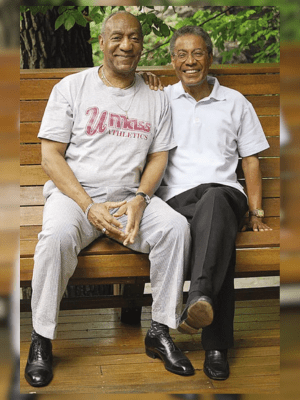
 Alvin Poussaint: My Involvement with “The Cosby Show”
When Haitian American medical doctor, Alvin F. Poussaint, first met comedian Bill Cosby backstage at a Black Expo in the 1970s, it was little more than a friendly exchange among men committed to uplifting the image of Black America. Years later, that chance meeting would lead to one of television’s most quietly influential partnerships.
As a consultant on “The Cosby Show,” Dr. Poussaint — who died in February at the age of 90 — became the show’s behind-the-scenes conscience, vetting every script to ensure it reflected the richness and diversity of Black life.
In one case, he noticed that every actress cast as Theo Huxtable’s girlfriend was light-skinned with straight hair. “I said, ‘Bill, who’s casting these people?’” Poussaint recalled in an interview roughly 15 years ago. “You can’t cast all light-skinned Black women with straight hair to be his girlfriend.”
“It shows how indoctrinated we are. Bill went to the casting director and said, ‘I want you to get some dates for Theo and I want them all to be pretty.’ That’s all he said. And the casting director said ‘Oh, pretty. Light skin, straight hair.’
“This is how institutional racism functions,” Poussaint said. “That casting director was doing what he thought was the pretty women as society defines them.”
That vigilance, born from his years as a civil rights doctor in the Deep South and honed over decades at Harvard Medical School, was central to Poussaint’s legacy, shaping how millions of Americans viewed the Black experience, on screen and beyond.
Born May 15, 1934, in East Harlem—a neighborhood of upper Manhattan in New York City—to Haitian immigrant parents, Poussaint understood from an early age the sting of prejudice and the power of representation. He earned his bachelor’s degree from Columbia University in 1956 and his medical degree from Cornell University Medical College in 1960, later completing psychiatric training at the UCLA Neuropsychiatric Institute, where he also earned a master’s in psychopharmacology.
In 1965, at the height of the civil rights movement, Poussaint became the Southern Field Director of the Medical Committee for Human Rights, based in Jackson, Miss. He treated civil rights workers wounded during marches — including the Selma and James Meredith “March Against Fear” — and worked to desegregate hospitals and health facilities across the South. “I saw medicine not just as a science, but as a tool for justice,” he often said.
 Democratic presidential hopeful Arkansas Gov. Bill Clinton and “Good Morning, America” co-host Charles Gibson confer before airtime in New York, June 23, 1992 in an extended breakfast table discussion. From left are Dr. Alvin F. Poussaint of Harvard, former Surgeon General C. Everett Koop, Gibson, Clinton, Spelman College President Johnneita B. Cole and Norman J. Orenstein, of the American Enterprise Institute. (AP Photo/Richard Drew)
By the time he joined the Harvard Medical School faculty in 1969, Poussaint was already thinking deeply about how systems — whether in health care or entertainment — shape public understanding of race. As faculty associate dean for student affairs and founding director of the Office of Recruitment and Multicultural Affairs, he recruited and mentored nearly 1,400 underrepresented medical students, integrating them into Harvard’s fabric and helping launch their careers in academic medicine.
Dr. Poussaint’s consulting work on “The Cosby Show” in the 1980s was an extension of that mission. Cosby enlisted him to review every script before it went into production, to eliminate stereotypes and ensure storylines were psychologically believable. He fought for story-driven plots over cheap punchlines and insisted that even a sitcom could model positive values like education, mutual respect and family love.
The civil rights doctor was equally prolific as a writer and thinker. He authored “Why Blacks Kill Blacks” (1972), co-authored Raising “Black Children” with Dr. James Comer (1992) and “Lay My Burden Down” with Amy Alexander (2000). His essays and speeches addressed race relations, the impact of media on children, violence and the need for nonviolent parenting.
Over his career, he earned numerous awards, including a New England Emmy in 1997 for “Willoughby’s Wonders” and the 2010 Herbert W. Nickens Award from the Association of American Medical Colleges for his contributions to justice in medical education and health care.
Dr. Poussaint died Feb. 24, 2025, at his home in Chestnut Hill, Mass., from medical complications after a short illness. He is survived by his wife of 32 years, Dr. Tina Young Poussaint; his son, Alan; his daughter, Alison; his sister, Dolores Nethersole; and numerous nieces and nephews.
In life, as in his work, Poussaint was unafraid to challenge the norms that limited the possibilities for Black Americans. Whether in a hospital boardroom, a civil rights march or a television studio, he insisted on a fuller, more accurate picture.
“I still watch a different world, and I still see myself in those shows and that’s a large part because of his contribution as a consultant in those spaces to make sure that black experiences were not a monolith,” said Dr. Nadia Monique Johnson, founder of Black Women’s Mental Health Institute.
“That they were not always presented as striving and in a deficient mindset. It showcased black individuals who are educated, thriving, raising families, and giving back to their community.”
The post Meet Alvin Poussaint, Haitian American doctor who helped shape Black America’s image on TV appeared first on The Haitian Times.
Via Haitian Times
Read original article
Comments (0)
Add a Comment
No comments yet