
NEW YORK—Among up-and-coming purveyors of arts and culture in the community, Tadia Tousssaint stands out for consistently working in the mainstream and being rooted in the Haitian community. The Emmy-nominated filmmaker splits time on music, her mainstay, and films–combining both this fall with the release of a konpa-flavored single years in the making, “Live My Life” featuring Haitian R&B artist Charlin Bato. The song comes with a companion film in which she stars as a spy out to stop Haitian corruption.
We caught up with Toussaint a couple after she dropped “Live My Life,” available on all streaming platforms, to discuss the significance of projects like hers as Haitian sounds, konpa specifically, permeate. The conversation has been condensed and edited for length and clarity.
The Haitian Times / Macollvie J. Neel: How are you feeling about this moment now after this release, both for you and for Haitian music overall? For our culture as Haitians?
Tadia Toussaint: I feel an immense responsibility as an artist to carry forth the sound, like God has revealed some chess pieces to me that I have to play. And with konpa kind of poking its head onto the global stage in the way that it did last year, it’s timely to push forward the sonic that represents us.
Literally, Bondieu mete’m la [God put me here] in New York, in the melting pot of the world, where I’ve grown up with other cultures that I get to see on the global stage all the time. So, I feel the responsibility to continue to lean into the power of influence and storytelling that artists have, which I think is one of the most profound things for an artist.
You know, music has an ability to travel far and wide, and it doesn’t necessarily have to be always completely understood. Music is really our only tourism right now that folks can experience. Like, that 4 Kampé moment was so special because it was like Haiti was trending for the first time and it wasn’t about something tragic. The Shade Room, the biggest American culture blogs, were reposting the song and saying, ‘Where my Haitians at?’
As artists, we want people from other places to hear us because we have something to share. As freedom fighters, it’s crazy that we’re still fighting for basic things. So when I look at just the climate globally, it’s clear ‘se pa nou menm selman kap viv [we’re not the only ones living] in a way that we want to scream, “let me live my life so nobody cannot take control.”
THT: How did “Live My Life” come to be?
Toussaint: I started recording “Live My Life” in Haiti in 2020. To get to the studio there, I had to cross a river. I remember watching kids playing and laughing on the way, and I thought, “They’re just living.” I was inspired by the simplicity and joy of the people I saw, and that moment birthed the song’s message: Living free of external forces trying to rob our everyday peace.
Later, I brought the song to a writing camp in the Poconos, where Jackson Chery helped give it a more urban, Americanized feel. When I played it for Charlin Bato he loved it and added a verse about control within romantic relationships, giving the song more emotional depth.
THT: So the song touches on many larger social themes.
Toussaint: There are many layers to it. At the time I was writing, I was hearing about Roe v. Wade, and the government trying to control our bodies and telling women what we need to do. Now, with 45 just taking away certain freedoms, like freedom of speech, it’s crazy how the timing aligned. In the lyrics, you’ll hear me say, “Can’t take advantage over my body. Thank God I got me.’ I’m talking to the government. I also say ‘nobody’s going to run this show of mine’ because, again, we should be in control of our time and what we do and what we say.
So, it’s something that I’m hoping could just re-inspire folks to remember that as many forces and things that try to come and control us, take control of yourself.
THT: You mentioned that people in Japan are discovering you. What’s that been like?
Toussaint: When I saw over 400 listeners in Japan in one week, it made me realize how far Haitian music can travel. That shows genuine global curiosity.
THT: There seems to be a growing effort among Haitian creators, like you, to bring our music to new audiences. What are you observing in this movement?
Toussaint: There’s a real attempt by many Haitian artists, producers, and creators to bring Haitian music to new stages. When you click on a playlist labeled “konpa,” you’ll find all sorts of Haitian music. Konpa has become shorthand for Haitian music in general, but Haitian music is so diverse.
For musicians and scholars, there’s a clear distinction between konpa and other genres, similar to classical versus jazz — they share roots but are defined by specific characteristics. Konpa has specific musical markers: its instrumentation, rhythm and cadence. It has also inspired subgenres like rabòday, which now fuses with amapiano, the South African electronic dance subgenre, to reach wider audiences. But for others, when they say “cross over,” they usually mean non-Haitian audiences engaging with Haitian music.
THT: How has the digital era affected reach and sound in this crossover landscape?
Toussaint: Younger generations are blending konpa with modern genres like hip-hop and drill. Depending on the market, that’s what “crossing over” looks like.
The record “4 Kampé” by Joé Dwèt Filé was a turning point. It was the first time I saw a Haitian song being played in non-Haitian spaces — in clubs, reels, and street parties. It broke in France first, then expanded to the English-speaking world with Burna Boy’s feature. That’s what real crossover looks like.
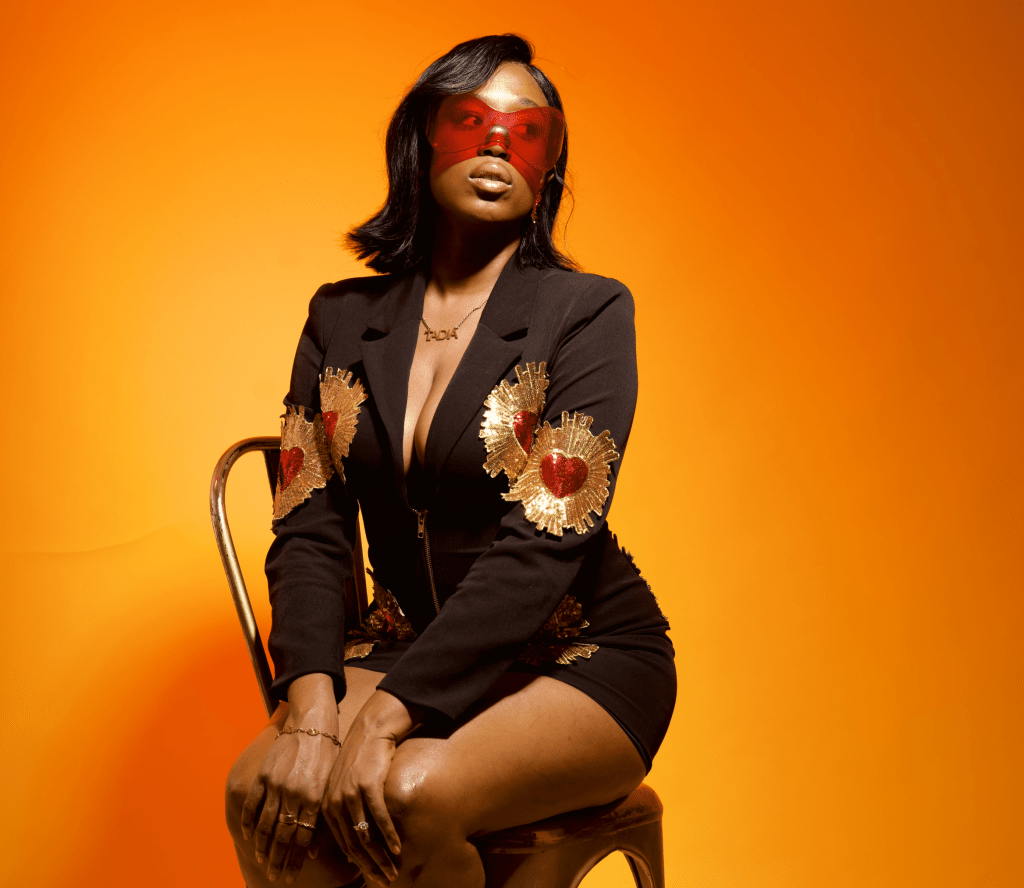
 Tadia Toussaint as “Brooklyn Goddess”. Courtesy of the artist
THT: Sounds like Joé Dwèt Filé’s model is the template in some ways – right? Yet, so many artists over the years have said the reason konpa couldn’t become like reggae, for example, is because of the language barrier. What’s your view?
Toussaint: I think Joé Dwèt Filé is the first Haitian to create a template, but the Afrobeat community, specifically Burna Boy, has done it. They [Africans] have their own language that’s not predominant English. Afrobeat, within the last 10 years or so, showed that the U.S. market will still very much consume the sonic if it sounds good, even if you pepper in your language.
Burna Boy had everybody saying, ‘I need igbo and shayo’ and we don’t know the words. I think also there is a songwriting strategy around how much of the English, how much of the other language, to include and then how much of the sonic sounds global. When it’s just konpa, it’s too foreign because it’s not as universally understood. So, I think the way to introduce it to new audiences is to blend it with other things [sounds] that people can recognize.
THT: How does this type of collaboration compare to what other artists, like Wyclef or Michael Brun, have been doing for years?
Toussaint: There’s a difference between a great collaboration and a song that ends up on everyone’s playlist. For example, the collaboration song with John Legend and Ruthshelle that Michael Brun did. But I haven’t gone to an event for anyone to be playing that song–yet, so I wouldn’t put it on the same level as “4 Kampé.” However, something should be said around bringing in international artists onto our sonic. It shows that people know our music, people are familiar with it, especially a legend like John Legend. I think that that’s still very powerful.
THT: What’s next for you?
Toussaint: Mwen komanse on chemin [I’m starting on a journey] that’s much bigger than myself. I’ve been engaged in our community in a very deep way in the last decade, and have an understanding of our community, the goals we’d like to accomplish as a collective and the hopes and dreams we have for Haiti. I think about all the storytelling and what impact representation has for Haiti. When I really sit down and fully assess, ‘how can I touch many corners of the world?’ You know, I have to use what God gave me, this musical gift.
What’s next is a four- to six-track EP and plans to start doing intimate live shows early next year. I want the performances to be healing spaces for people. I’m also releasing a short film called “The Last Mission” to accompany “Live My Life.” I play Agent Choublak, a special agent on a mission to stop a corrupt Haitian official. It’s symbolic — about fighting corruption and reclaiming our power.
THT: I love it! Can’t wait to watch.
The post Tadia on her new single, konpa crossovers and finding freedom through sound appeared first on The Haitian Times.
Via Haitian Times
Read original article
Comments (0)
Add a Comment
No comments yet