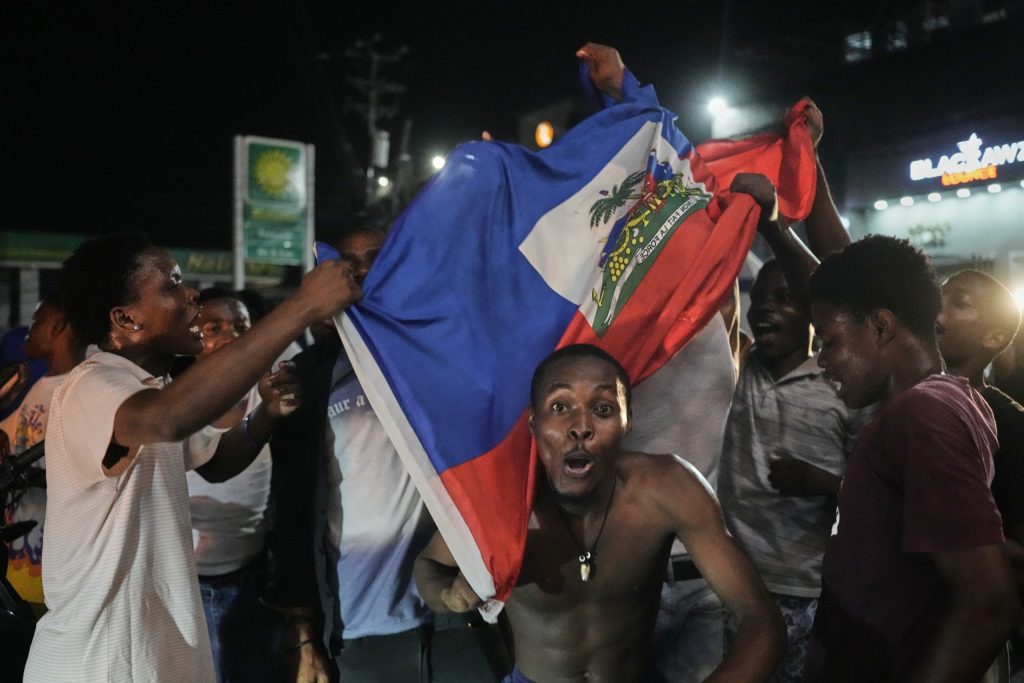

‘Grenadye, alaso!’
Few phrases stir Haitian pride and collective memory the way this short rally cry does. Rooted in Haiti’s revolutionary era, it means, sportingly, “Warriors, let’s go.”
Chanted in moments of combat and celebration, the phrase derives from “Grenadiers, à l’assaut,” a French military command that translates to “Troops, attack!” Colonial French officers used the call to signal special forces infantry units to advance on the enemy during battle. Enslaved ancestors who served in France’s armies made the phrase theirs—just as they claimed the land and turned Saint-Domingue into the First Black Republic.
As the nation’s heroes of independence went on the attack against their enslavers, they repeated the phrase to rally the troops and keep morale high, merging ‘à l’assaut’ into one word as they marched toward liberation.
 Haiti’s men’s national soccer team before taking on Azerbaijan in a friendly match at Mehdi Huseynzade Stadium in Sumqayit, Azerbaijan, on March 22, 2025. The game was played on the Haitian team’s 100th anniversary. Photo via Haitian Football Federation’s Facebook
Instilling national pride
In Haiti, schoolchildren learned the phrase as part of a song the freedom fighters sang in unison. Its call-and-response style echoes the rhythm of African culture, making it easy for children to remember as they took turns calling out and repeating the lines together.
Grenadye, alaso.
Sa ki mouri zafè a yo.
Nanpwen Manman, nanpwen Papa
Sa ki mouri zafè a yo.
Loosely translated, the war song calls for soldiers to attack, to march on past those who’ve perished behind and forget about loved ones in the march.
In many retellings of the Haitian revolution inside classrooms and living rooms, children also learn that when troops were tired, they refused to give up and would respond to the call with ‘Nou la toujou’ — meaning “We’re still here.”
From the battle field to the soccer pitch
Over time, “Grenadye, alaso” has become a symbol of unity, shared struggle and anticipated victory. It appears in political speeches, konpa lyrics, diaspora gatherings and everyday conversations.
Sometimes it simply means “stay strong.” Other times, it means “let’s move together.” Or, “Nou nan konba,” another phrase meaning we’re in a fight.
When Haiti established its national football team in 1904, one of the earliest in the Caribbean, it aptly chose the name “Les Grenadiers.” It embodies resistance, unity and defiance in the face of overwhelming odds—qualities that have become inseparable from Haiti’s identity.
 Haitian player Lourdjina Etienne, along with her teammates, celebrating their victory against El Salvador during the second day of the Concacaf U17 Championship in Mexico on February 3, 2024. Photo credit: Concacaf Women.
The women’s national team carries the parallel name “Les Grenadières,” a feminized form that upholds French grammatical convention. Together, the two teams represent a modern evolution of a centuries-old ethos: Haitians advancing despite adversity.
More than a nickname, players often shout the phrase before each match, just like soldiers charging into battle.
A cultural cry heard across the globe
Now, for Haitians across the globe — whether in Port-au-Prince, Cap-Haïtien, Brooklyn, Willemstad (Curaçao), Provinciales (Turks and Caicos), Rio de Janeiro, Santiago (Chile), Santo Domingo, Mexico City, Paris or Doha (Qatar) — “grenadye, alaso” is an affirmation of identity and anticipated victory.
Grenadye, alaso.
Nou la toujou.
The post Why “Grenadye, alaso” is Haiti’s World Cup rally cry appeared first on The Haitian Times.
Via Haitian Times
Read original article
Comments (0)
Add a Comment
No comments yet