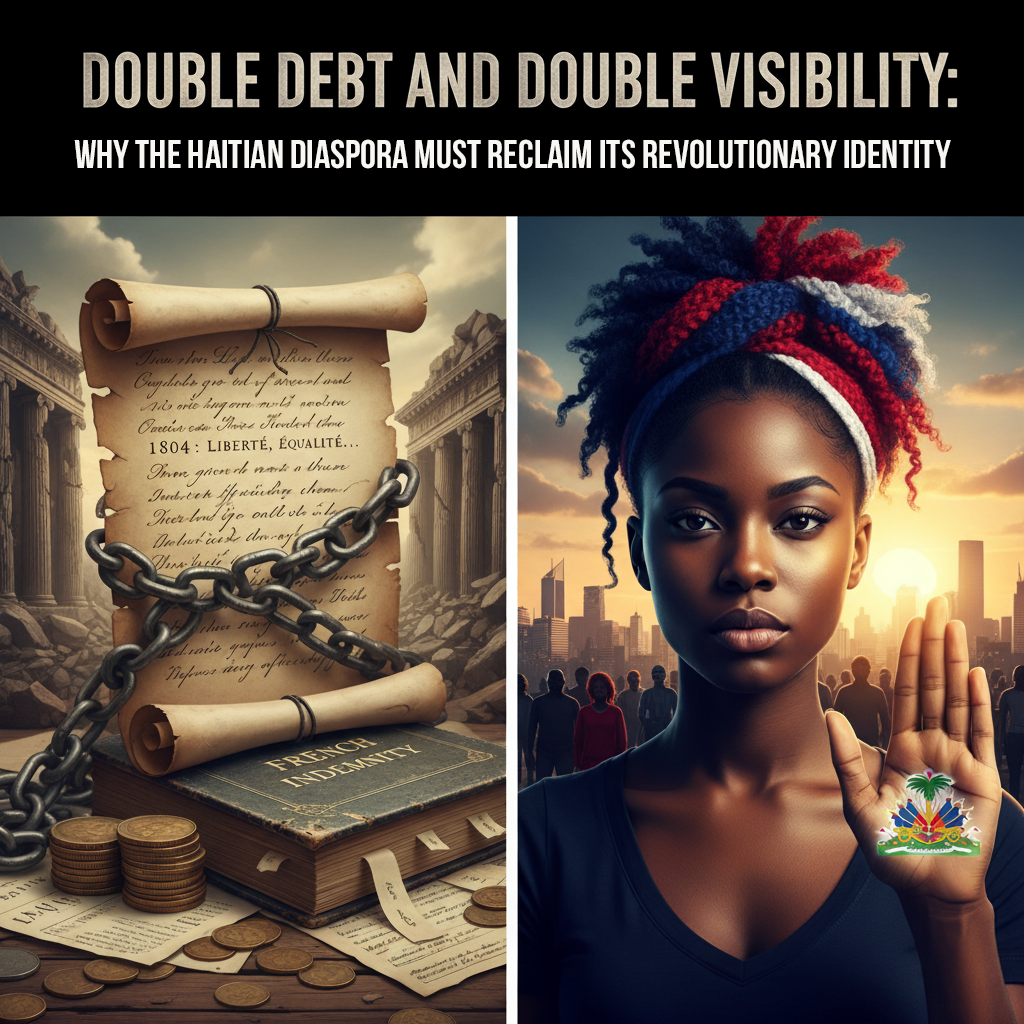
As the second independent nation in the Americas and the world’s first free Black republic born from a successful slave revolution , Haiti radically shifted the course of global affairs, compelling the end of the transatlantic slave trade and even influencing key Western geopolitical decisions, such as the Louisiana Purchase. However, this moral triumph was met not with recognition but with immediate, profound isolation and systemic antagonism by slaveholding powers, including the United States, which withheld official recognition until 1862.
This isolation established a dangerous paradigm: the success of the Black republic was treated as an existential threat, laying the groundwork for two centuries of external punishment and anti-Black nativism. The resulting Haitian identity crisis experienced by the Haitian diaspora today is not merely an effect of contemporary poverty or political instability; it is the lingering consequence of an engineered failure rooted in history.
The Architecture of Structural Collapse: Haiti's Engineered Crisis:
The nascent republic was fundamentally crippled by external financial coercion. In 1825, France demanded a massive indemnity from Haiti—a payment intended to compensate former French slaveholders for the "loss" of their property, including the enslaved population. This indemnity was structurally designed to ensure failure, creating a "double debt" mechanism where Haiti not only made direct payments but also incurred interest loans from French and later American bankers to meet the annual demands.
The economic consequences were devastating and intergenerational. By the late 1800s, an astonishing 80% of Haiti’s national wealth was dedicated to servicing this foreign debt. This financial strangulation preempted any possibility of funding public services, infrastructure, or education, establishing a permanent state of economic fragility that precluded legitimate state-building.
Critically, this engineered vulnerability created the conditions for the internal political catastrophe known as the "fatal flaw." Analysts identify this flaw as the domination by self-interested economic and political elites who perceive every political or economic issue as a zero-sum game, leading to no consensus or desire to advance the country. These elites exploit the system, avoid taxes, and restrict social mobility, benefiting from the chaos that keeps the state fragile. Thus, the chronic instability and violence that drive mass migration—from fleeing tyrannical regimes like Duvalier to escaping current insecurity —are inherited symptoms of 19th-century financial architecture, institutionalized by self-serving local leadership.
The Diaspora's Dilemma: Stigma and Strategic Identity Denial:
Faced with a nation defined globally by perpetual crisis, political chaos, and historical stigma—a narrative sometimes amplified by events like the discrimination stemming from the 1980s AIDS crisis —Haitian migrants abroad encounter a complex sociological dilemma. While many maintain a deep pride in their heritage, where "Black" is synonymous with "unflinching independence" , this pride clashes violently with pervasive prejudice in host countries.
In racially stratified societies, Haitians often suffer a "double visibility," seen as Black by whites and as foreigners by native-born Black populations. This leads to intense pressure to assimilate. The attempt to deny or distance oneself from Haitian roots becomes a strategic effort to improve social standing and escape stigma (the lost of identity). Research indicates that Haitians on the lower socioeconomic scale are more likely to hide their ethnicity, whereas those on the higher end may embrace the hyphenated Haitian-American identity.
Among second-generation Haitian immigrants, a common strategy is to actively differentiate themselves, impressing others with their non-African American background or even asserting a sense of superiority over other Black groups by emphasizing values such as hard work and achievement. This attempt to trade national affiliation for perceived social mobility is a coping mechanism, diverting collective intellectual and financial energy away from supporting the homeland and towards individual survival within the host country’s racial hierarchy.
The Hard Truth of Inescapable Identity at the Border:
The assimilation strategies employed by the Haitian diaspora are rendered tragically futile when confronted by the operational reality of host nation immigration policy. U.S. policy, consistently treating Haiti and Haitians as a "laboratory of anti-Black racism" , proves that an individual's self-selected identity—whether "Black," "immigrant," or "non-Haitian"—is irrelevant when confronting the state.
The 2021 incident in Del Rio, Texas, provided searing evidence of this imposition. The U.S. government deployed border agents on horseback against largely Black Haitian migrants, an action described by Human Rights Watch as reflective of "abusive and racially discriminatory immigration policies". This deployment, along with the mass expulsions under Title 42—a policy used disproportionately against Black and Latino asylum seekers on false public health grounds —served as a violent reclassification.
The state apparatus enforces one identity above all others: Haitian immigrant. The images of predominantly white federal agents pursuing Black migrants recalled disturbing U.S. history of racial violence, including that perpetrated by slave patrols. When push comes to shove, the state enforces national origin, returning people to a nation where leaked internal documents confirm they face serious harm, including crime, political crisis, and kidnapping. This undeniable experience of collective persecution under duress must serve as the ultimate catalyst for the diaspora to abandon identity denial and embrace solidarity.
Reclamation for Reconstruction: A New Mandate for Nation-Building:
For Haiti to move beyond its status as a fragile, aid-dependent state, a fundamental shift in perspective and action is required from both those residing on the island and the global diaspora. The first step must be the conscious reclamation of their identity and the revolutionary mandate of 1804, translating historical pride into active, political engagement focused on nation-building.
The lesson of the border crisis is that the identity of "Haitian" is immutable under duress; therefore, the solution is not denial but unification based on that shared reality. The extensive global diaspora, possessing intellectual and financial capital , must channel its energy toward correcting the "fatal flaw" of internal elite exploitation.
As internal reform is acknowledged as a necessary precondition for any foreign aid to work effectively, and outsiders cannot fix this problem , Haitians must resolve their governance issues, confront deep-seated racial and class divisions, and build a wide consensus about the country’s future direction. The diaspora is uniquely positioned to fulfill this mandate by leveraging its transnational identity to fund strategic initiatives in health and education that bypass corrupt government channels. True sovereignty requires moving beyond the acceptance of foreign aid—which has often served only to prop up the dysfunctional system and enrich the elites —and establishing an operational, unified state where governance is for the benefit of all citizens, not just the self-interested few. It is time for the world’s first free Black republic to finally claim the uncompromised independence it sacrificed so much to achieve. 
Comments (1)
Add a Comment
Joel Izmery
October 7, 2025Haiti will rise again!