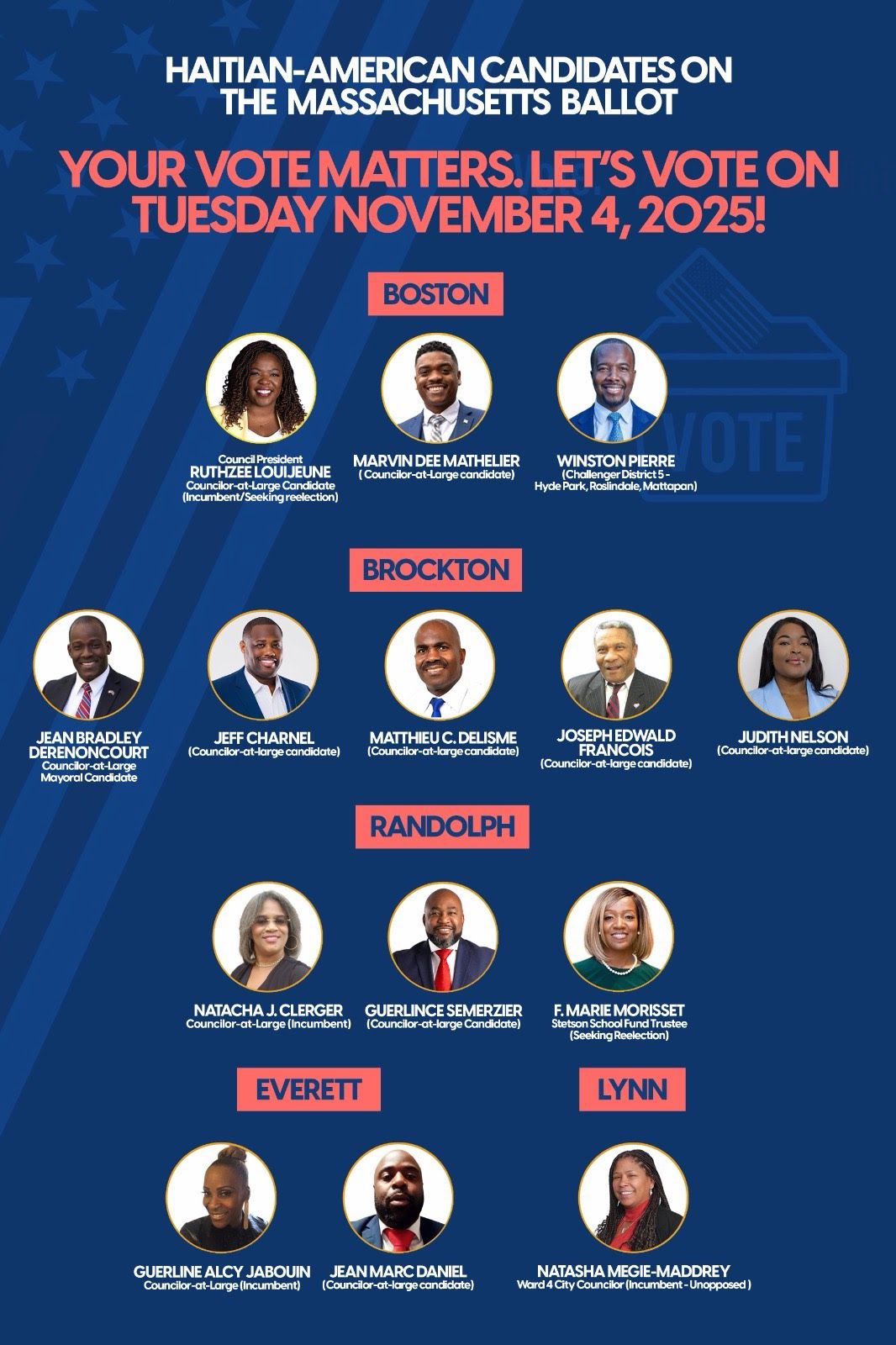
However, this unprecedented surge also presents a strategic challenge: vote fragmentation. In several cities, multiple Haitian-American candidates are vying for the same seats, raising the risk of divided support that could weaken the community’s collective impact. The true test of this election will be whether Haitian-American voters can unite strategically — turning this wave of ambition into lasting political power rather than allowing internal competition to dilute their strength.
The opportunity is clear: if the community mobilizes decisively and votes in unity, 2025 could be remembered as the year Haitian-Americans reshaped the political landscape of Massachusetts.
From Diaspora to Political Force
Over the past half-century, Haitian immigrants have become one of Massachusetts’ most dynamic communities. Concentrated in Boston, Brockton, Randolph, and Everett, Haitian-Americans have built thriving neighborhoods, churches, and businesses. Today, they are ready to extend that progress into the civic arena — running for office in record numbers.
This election cycle is not simply a collection of individual races; it represents a collective movement toward political empowerment. The outcomes will reveal whether the community can transform cultural influence and economic contributions into consistent, coordinated political strength.
Boston: The Epicenter of Leadership
Boston’s ballot features three Haitian-American candidates — all deeply rooted in community service and leadership.
Council President Ruthzee Louijeune, the first Haitian-American ever elected to Boston’s municipal government, is seeking re-election as Councilor-at-Large. Her tenure as Council President has been marked by bold advocacy for affordable housing, voting rights, and equity for immigrant communities. Her success has become a blueprint for emerging Haitian-American leaders statewide.
Marvin Dee Mathelier, a U.S. Army veteran, small business co-owner, and director of the Toussaint Louverture Cultural Center, is running for Councilor-at-Large. He champions affordable housing, small business growth, and mental health resources — embodying the values of service and empowerment.
Winston Pierre, a city planner and Hyde Park resident, is challenging for a District 5 City Council seat, representing Hyde Park, Roslindale, and Mattapan. His platform centers on ethics, transparency, and equitable development — a grassroots call for fair representation in historically underrepresented neighborhoods.
Together, these candidates symbolize Boston’s Haitian-American political renaissance — a movement grounded in integrity, experience, and shared community vision.
Brockton: The Crucible of Collective Power
Brockton — home to one of the largest Haitian populations in Massachusetts — could become the first city in state history with a Haitian-American majority on its City Council if voters unite strategically.
Running for Councilor-at-Large are:
Jean Bradley Derenoncourt, a current Councilor-at-Large and Mayoral candidate, whose historic 2017 election made him one of the city’s youngest Haitian-American officials.
Jeff Charnel, a commercial banker and community leader advocating for small business growth and accessibility in city services.
Matthieu C. Delisme, a pastor and community servant emphasizing moral leadership and civic responsibility.
Joseph Edwald François, a respected civic figure and Councilor-at-Large candidate.
Judith Nelson, an advocate for youth empowerment and education.
The breadth of Haitian representation in Brockton reflects a community ready to lead — but it also underscores the necessity for strategic voting and coordination to prevent internal vote splitting. A united front could deliver an unprecedented governing presence.
Randolph: A Test of Strategic Unity
In Randolph, where Haitian-Americans make up a growing share of the electorate, three strong community leaders are on the ballot:
Natacha J. Clerger, Councilor-at-Large incumbent, is seeking re-election after years of public service and advocacy.
Guerlince Semerzier, a nonprofit consultant and leadership coach, brings a record of civic engagement and mentorship within the Haitian diaspora.
F. Marie Morisset, a trustee at Stetson School, is seeking re-election and remains a strong advocate for youth and education.
Their combined presence showcases both the talent and challenge of representation: will Randolph’s Haitian-American voters unify behind a cohesive strategy to preserve and expand their influence?
Everett and Lynn: Sustaining Representation
In Everett, Guerline Alcy Jabouin, an incumbent Councilor-at-Large, seeks re-election, joined by Jean Marc Daniel, a new candidate for the same position. Their campaigns reinforce Everett’s growing Haitian footprint and the community’s commitment to retaining its political seat at the table.
In Lynn, Natasha Megie-Maddrey, the Ward 4 City Councilor (incumbent, unopposed), exemplifies Haitian-American political stability and progress. Her continued leadership ensures that Haitian voices remain represented in one of the North Shore’s most diverse cities.
Conclusion: Turning Momentum into History
The 2025 Massachusetts municipal elections are not just another election cycle — they are a defining chapter in the Haitian-American story. Across Boston, Brockton, Randolph, Everett, and Lynn, the ballot is filled with leaders who reflect a generation of progress, resilience, and vision.
Yet, success depends on one simple act: unity at the ballot box.
If the Haitian community votes together, November 4, 2025, will mark a historic breakthrough — transforming decades of community organizing into enduring political power. This is not merely an election; it is a referendum on whether the Haitian-American community is ready to step forward together, not as isolated candidates, but as a unified force shaping the future of Massachusetts.
Comments (0)
Add a Comment
No comments yet