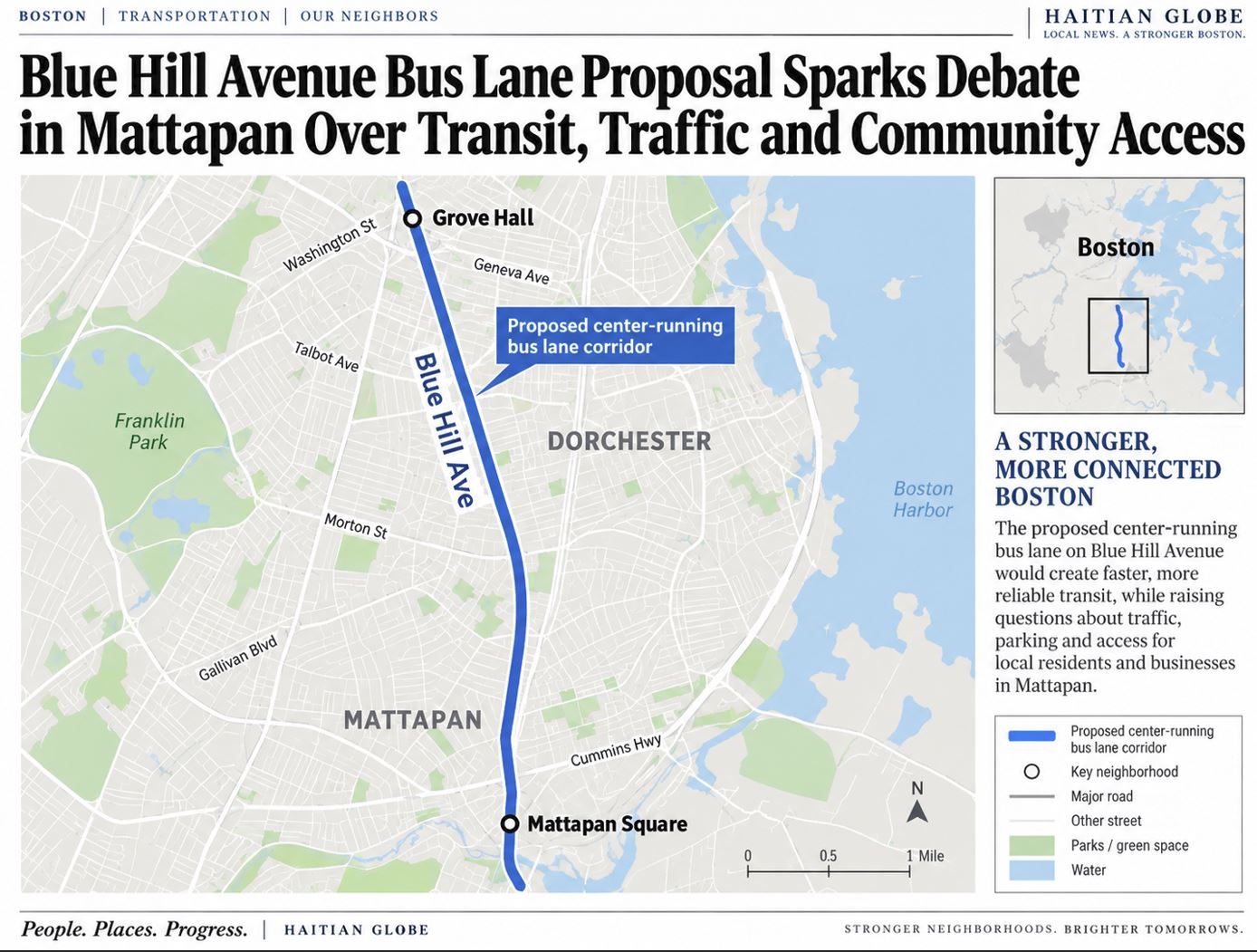
Blue Hill Avenue has long served as a vital transportation and commercial corridor connecting Mattapan, Dorchester and surrounding Boston neighborhoods. For many Haitian and Haitian American families, the avenue is part of daily life—a place to shop, conduct business, attend church, visit community organizations and travel to work or school.
Now, a proposal to introduce center-running bus lanes along portions of Blue Hill Avenue has sparked debate over how the busy roadway should be redesigned and whose transportation needs should receive priority.
The proposed improvements are part of Boston's Better Blue Hill Avenue initiative , which seeks to improve public transportation, pedestrian safety and mobility along the corridor. However, opposition from some Mattapan residents has highlighted concerns about traffic congestion, business accessibility, parking and the potential effects of major roadway changes on the surrounding community.
At the center of the discussion is a question that affects residents regardless of how they travel: How can Blue Hill Avenue accommodate buses, private vehicles, pedestrians, cyclists and local businesses while remaining accessible to the communities that depend on it?
What Is Being Proposed?
The City of Boston and the Massachusetts Bay Transportation Authority (MBTA) are proposing a major reconstruction of approximately three miles of Blue Hill Avenue between Mattapan Square and Grove Hall.
The centerpiece is a dedicated, two-way bus corridor in the middle of the roadway. Instead of boarding buses at traditional curbside stops, passengers would use designated platforms in the center of the avenue.
According to city officials, the project could improve transportation for approximately 40,000 daily bus riders, with the Route 28 bus potentially saving 10 to 15 minutes between Mattapan Square and Grove Hall. Other routes, including the 22, 29 and 31, could also benefit.
The revised design, released in September 2026, includes additional parking, reconstructed sidewalks, accessible pedestrian ramps, improved traffic signals and approximately 200 new trees.
City officials say the latest proposal preserves at least two general-purpose travel lanes in each direction along more than 70% of the corridor. The updated design also provides 42 more parking spaces than currently exist within the project area.
Despite these adjustments, the center-running bus lanes remain a source of disagreement.
Mattapan Residents Raise Safety Concerns
On September 10, residents gathered along Blue Hill Avenue to protest the proposal as Mayor Michelle Wu and MBTA General Manager Phillip Eng attended a community listening session.
According to NBC Boston , demonstrators expressed concerns about requiring passengers to cross active traffic lanes to reach bus platforms in the middle of the road.
Mattapan resident Louis Elisa, speaking to NBC Boston in a September report, questioned the safety of the design for mothers with young children and older residents who would need to cross traffic to board buses.
These concerns are particularly relevant to families who depend on public transportation but also need convenient access to bus stops while traveling with children, groceries or mobility equipment.
For residents who rely on buses, the debate is not only about travel times. It is also about reaching bus stops safely, preserving access to local businesses and ensuring that street improvements work for people of different ages and mobility needs.
City officials maintain that the proposed redesign would improve pedestrian safety through new crossings, signals, sidewalks and accessible boarding facilities. Nevertheless, the disagreement highlights the importance of examining how passengers would safely reach the platforms under everyday traffic conditions.
Small Businesses and Parking Remain Major Concerns
Blue Hill Avenue is more than a transportation route. Its businesses, restaurants, religious institutions and community gathering places support the economic and social life of Mattapan and surrounding neighborhoods.
For Haitian-owned businesses and other neighborhood establishments, convenient access can influence whether customers stop to shop, pick up food or obtain services.
Some opponents worry that changes to traffic patterns, parking and loading areas could discourage customers or complicate deliveries.
The city says its revised proposal addresses some of these concerns by increasing available parking and introducing location-specific accommodations for businesses and religious institutions.
Officials have also committed to working with merchants and faith-based organizations to develop measures addressing construction-related disruptions.
However, the practical effects on individual businesses will depend on the final street design, parking regulations, construction schedules and access arrangements.
For Haitian entrepreneurs operating along or near Blue Hill Avenue, understanding these details is essential to evaluating how the project could affect their daily operations.
Supporters Point to Faster, More Reliable Transportation
Supporters of dedicated bus lanes argue that removing buses from regular traffic would make public transportation more dependable.
For residents who commute to work, attend medical appointments or rely on transfers to other MBTA services, shorter and more predictable travel times could provide meaningful benefits.
The proposed improvements would also include a complete reconstruction of the roadway and sidewalks, addressing infrastructure needs along a corridor that city officials acknowledge requires significant investment.
The latest project design carries an estimated cost of approximately $163 million, according to reporting by The Boston Globe. Construction is expected to begin in phases in 2027 and continue through 2030.
Supporters view the project as an opportunity to improve bus service while upgrading the surrounding streetscape. Opponents, however, question whether similar improvements could be delivered without placing bus lanes in the center of the road.
An Alternative Proposal: Expanding Rail Service
The disagreement has also reached Boston City Hall.
City Councilors Miniard Culpepper and Brian Worrell have raised objections to the proposed center-running bus lanes and called for consideration of an Orange Line extension from Ruggles Station toward Mattapan Square.
In March 2026, the councilors sponsored a resolution urging the city and MBTA to cancel the center-running bus lanes and redirect associated funding toward the continuation of fare-free bus service.
The resolution was referred to the City Council's Committee on Planning, Development and Transportation.
An Orange Line extension would represent a substantially different transportation investment, requiring separate planning, funding and implementation decisions.
The existing bus-lane proposal remains the project currently being advanced by the city and MBTA.
What Does This Mean for the Haitian Community?
For Haitian and Haitian American residents of Mattapan, the Blue Hill Avenue debate involves several overlapping priorities: reliable transportation, safe streets, access to neighborhood businesses and meaningful participation in decisions affecting their community.
A Haitian family that depends on the Route 28 bus may welcome shorter travel times. A Haitian business owner may be more concerned about customer parking and deliveries. An older resident may prioritize the safety and accessibility of bus stops.
These perspectives are not necessarily in conflict, but they illustrate why a single transportation project can affect community members differently.
Although local news coverage documents opposition among Mattapan residents, Haitian Globe has not independently established a representative position among Haitian residents or Haitian-owned businesses regarding the proposal.
Their direct experiences and opinions deserve to be included in the continuing public discussion.
What Happens Next?
The September 2026 design revisions demonstrate that the city and MBTA have made changes following community feedback, although the central bus-lane proposal remains.
Residents can review project information through the Better Blue Hill Avenue website and follow public engagement opportunities announced by the City of Boston and MBTA.
For Haitian families, business owners and community leaders, the continuing discussion offers an opportunity to raise specific questions about pedestrian safety, transportation reliability, business access and neighborhood infrastructure.
As Boston moves forward with planning, the experiences of those who travel, work and conduct business along Blue Hill Avenue will remain central to understanding the proposal's potential effects on Mattapan and the surrounding communities.
Haitian Globe® will continue following developments and welcomes firsthand perspectives from Haitian and Haitian American residents, business owners and community organizations affected by the proposed redesign.
Comments (0)
Add a Comment
No comments yet