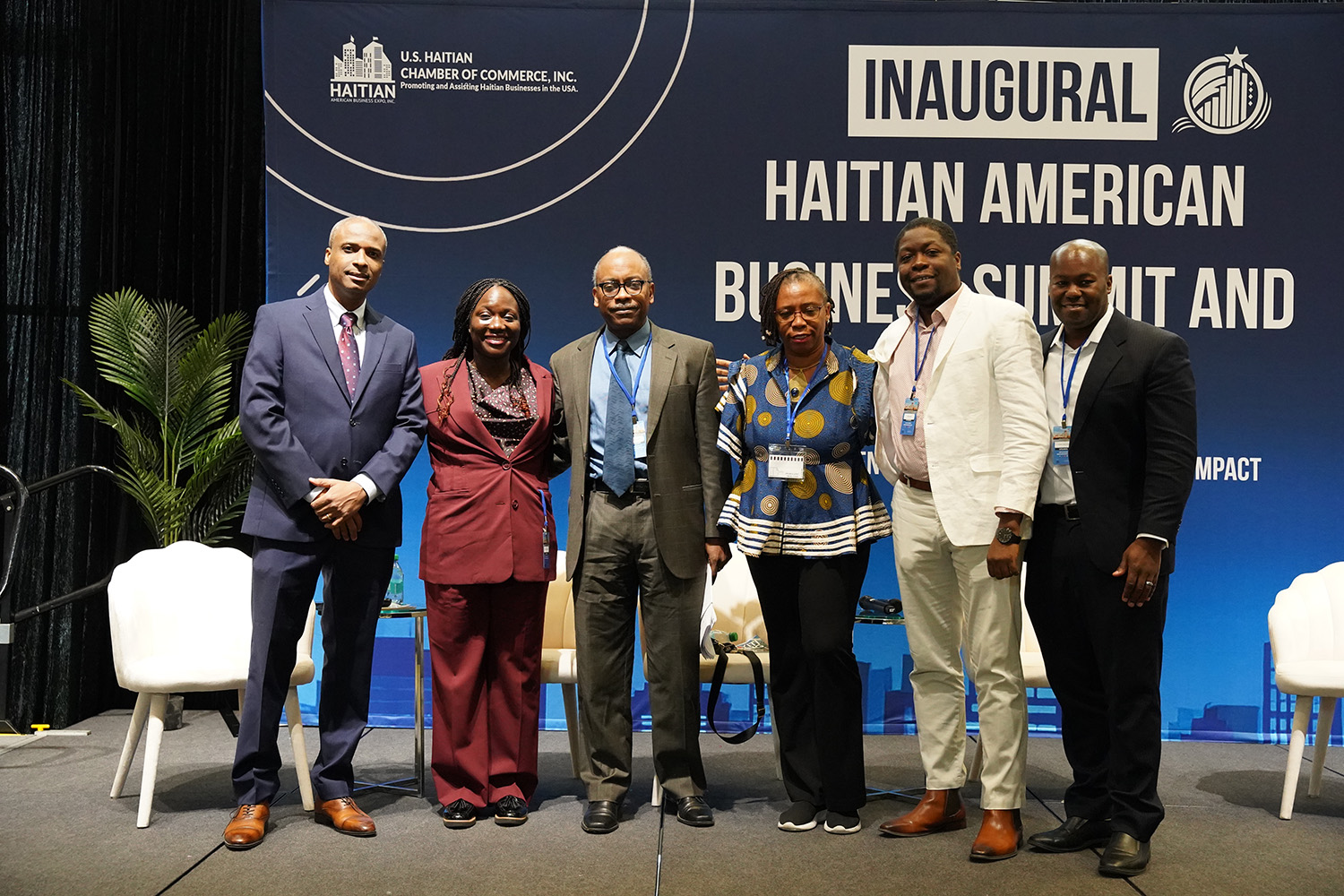
RANDOLPH, MASSACHUSETTS — With just 20 days remaining before the Second Annual Haitian American Business Summit, momentum is building across the Haitian American business and professional community for a gathering centered on trade, investment and Haiti's economic future.
Organized by the U.S. Haitian Chamber of Commerce, the Summit takes place Saturday, October 31, 2026, at the Blue Hills Ballroom in Randolph, Massachusetts. According to the Chamber, 55 speakers have been confirmed, with additional announcements anticipated as preparations enter their final weeks.
Yet the story behind the growing speaker lineup reaches beyond a single conference. The Chamber is advancing a national chapter initiative across 14 states, building alliances with community and professional organizations, and preparing to unveil an expanded platform intended to connect producers in Haiti with commercial buyers in the United States.
Under the theme “Rebuilding Haiti Through Business, Trade & Diaspora Leadership,” the event is built around a central question: How can Haitian professionals, investors, entrepreneurs and institutions translate the diaspora's talent and relationships into sustained economic results?
Haiti's economic future will require more than conversation. It will require cooperation, commercial partnerships, and institutions capable of turning ideas into action.
Prominent Speakers Reflect the Summit's Growing Reach
The Chamber has already introduced several prominent voices from economics, public policy, business, community advocacy and international commerce. Its announced speaker lineup includes:
Kesner Pharel — Economist, financial analyst, and Chairman and CEO of Group Croissance S.A., bringing expertise in economic policy, finance and development.
Wolf Pamphile — Founder and CEO of Haiti Policy House, contributing perspectives on governance, public institutions and policy reform.
Elsie Saint Louis — CEO and Executive Director of Haitian Americans United for Progress (HAUP), with extensive experience in community leadership and advocacy.
Jeffsky Poincy — Founder and Lead Policy Analyst of Haiti Briefing, contributing analysis of Haiti's governance, elections and democratic stability.
Mrs. Andress Appolon — President of the American Chamber of Commerce of Haiti, bringing a business and cross-border trade perspective.
Angie Bell — Former Mayor of Cap-Haïtien, bringing experience in municipal leadership and local development.
Other announced contributors include Dr. Gabrielle Abelard, Dr. Martine Gordon, Joan Macenat, Ernst Guerrier, Henry Milorin, Marie Myka Texas and Rose Mica Georges, among additional speakers and moderators representing law, finance, technology, healthcare, entrepreneurship and public service.
Sources familiar with preparations say organizers are also coordinating participation from figures connected to government, major corporations and international institutions. Some names have not yet been formally announced; their anticipated participation should not be confused with public confirmation.
The diversity of expertise reflects a deliberate approach: Haiti's economic future cannot be discussed solely through the lens of politics, nor can business development be separated from security, governance, capital and functioning institutions.
A National Coalition Takes Shape Across 14 States
A defining element of this year's Summit is the Chamber's national expansion initiative, which seeks to develop a stronger network of Haitian American business leadership through chapters and emerging chapter efforts spanning 14 states.
For generations, Haitian Americans have established businesses, professional associations and respected community institutions throughout the United States. But much of that talent and influence has remained dispersed across cities, sectors and independent organizations.
The Chamber's expanding network aims to build new connections across those boundaries, enabling referrals, partnerships, professional exchanges, entrepreneurial support and stronger cooperation on shared economic priorities.
Organizations supporting the Summit and its wider community engagement include the National Alliance for the Advancement of Haitian Professionals (NAAHP), Haitian Americans United for Progress (HAUP), NHAEON and other prominent organizations across the United States. These independent partners are part of a broader ecosystem of institutions engaging with the Chamber's efforts, rather than necessarily being chapters themselves.
The ambition is to move from scattered individual influence toward a more organized national presence: one capable of engaging financial institutions, corporations, policymakers, investors and international partners on a larger scale.
A New Commercial Bridge Between Haiti and the United States
Among the most anticipated developments is the planned unveiling of a major expansion of HaitianBusiness.org, the Chamber's existing business directory and business-to-business marketplace.
The expanded initiative is intended to connect Haitian farmers, manufacturers, exporters, producers and entrepreneurs with U.S.-based importers, retailers, wholesalers, distributors, investors and Haitian American businesses.
Its proposed features include buyer-and-supplier matchmaking, sourcing requests, product discovery, wholesale opportunities, export leads and direct business introductions. The Chamber also hopes to establish relationships with trade associations and commercial partners on both sides of the border.
The opportunity is tangible. A Haitian agricultural cooperative might find a U.S. buyer. A Haitian American grocery chain might discover new suppliers in Haiti. A manufacturer might find distribution partners capable of expanding its market reach.
Such transactions are not guaranteed, and the proposed expansion will require implementation and sustained cooperation. But the idea points to an important shift: alongside remittances and humanitarian support, diaspora engagement can also help strengthen productive industries, trade relationships and employment.
The overarching question is direct: What becomes possible when Haiti can produce more, sell more and build stronger links to the purchasing power of its global diaspora?
From Political Crisis to Practical Economic Solutions
The Summit arrives as Haiti continues to confront severe insecurity, political uncertainty, limited investment and disruption to everyday commercial life. Those challenges cannot be ignored in discussions about economic recovery.
The agenda includes conversations on elections and democratic stability; security, recovery and job creation; U.S.–Haiti trade, manufacturing and exports; and the mobilization of diaspora resources for economic impact.
Additional discussions will cover entrepreneurship, access to capital, investing in Haiti, digital governance, artificial intelligence, technology and related business challenges.
These topics are intertwined. Investors need confidence. Businesses need reliable supply chains and access to capital. Trade needs functioning systems and commercial trust. Sustainable growth depends on institutions, skills and a stable operating environment.
By gathering leaders across disciplines, the Summit aims to create space not only to examine what has gone wrong but to discuss what businesses, professionals and institutions can realistically do next.
Why Haitian American Professionals Should Join the Conversation
Across the United States, Haitian Americans are leading companies, practicing medicine, shaping public policy, managing financial services, building technology ventures, working in education and helping communities flourish.
What remains is the challenge of turning that individual success into coordinated, lasting economic influence.
For entrepreneurs, the Summit may open doors to customers, financing, vendors and partnerships. For established corporate professionals, it offers a chance to connect experience and institutional relationships with projects of broader significance. Young professionals can encounter mentors and new networks, while investors and policymakers can hear directly from people operating businesses and institutions linked to Haiti.
The value of participation extends beyond the formal panels. Some of the most useful outcomes may begin with an introduction, a follow-up meeting, a sourcing lead or a partnership that continues long after the event.
The Haitian diaspora cannot remain merely a collection of successful individuals. Its long-term influence will depend on the ability to collaborate, organize and act together.
Ticket Demand Adds to the Momentum
The Chamber reported that approximately 75% of the Summit's capacity had been filled as of October 10, a figure that signals considerable interest ahead of the event. Organizers are encouraging interested professionals and business owners to register early because attendance is limited.
The gathering is expected to feature panels, workshops, networking opportunities and an exhibitor marketplace, giving participants multiple ways to engage with businesses and organizations across the diaspora.
A Weekend Celebrating Leadership and Excellence
The weekend continues on Sunday, November 1, with the Chamber's 7th Annual Haitian American Young Professional Awards Gala, celebrating emerging Haitian American professionals, entrepreneurs, leaders and community changemakers.
The Chamber previously announced 25 finalists selected from more than 200 nominations. While the Summit focuses on economic strategy and collaboration, the Gala recognizes the next generation of people whose leadership may shape the community's future.
Beyond the Summit: The Real Test Will Be What Happens Next
With 55 speakers confirmed, an expanding 14-state network, support from prominent community organizations and a U.S.–Haiti trade initiative approaching its unveiling, the Second Annual Haitian American Business Summit has become a significant focal point for discussions about diaspora-driven economic development.
Its lasting impact, however, will not be measured solely by attendance, stage appearances or the number of partnerships discussed during the weekend.
It will depend on whether new relationships become durable partnerships, whether commercial leads become real transactions, whether diaspora organizations coordinate more effectively, and whether the professional expertise assembled in Massachusetts leads to sustained action.
For a diaspora rich in talent, influence and economic potential, the question is no longer whether Haitian Americans can contribute to Haiti's future. The question is whether they can organize, collaborate, invest and lead at the scale necessary to help transform it.
On October 31, that conversation moves to center stage in Massachusetts.
The momentum is building. The national network is expanding. The opportunities are taking shape. And the time to move from conversation to action is now.
Event Information
Saturday, October 31, 2026 | 9:00 AM – 6:00 PM
Blue Hills Ballroom, 21 Scanlon Drive, Randolph, MA 02368
Theme: Rebuilding Haiti Through Business, Trade & Diaspora Leadership
7th Annual Haitian American Young Professional Awards Gala
Sunday, November 1, 2026 | Blue Hills Ballroom
View announced speakers
Comments (0)
Add a Comment
No comments yet